
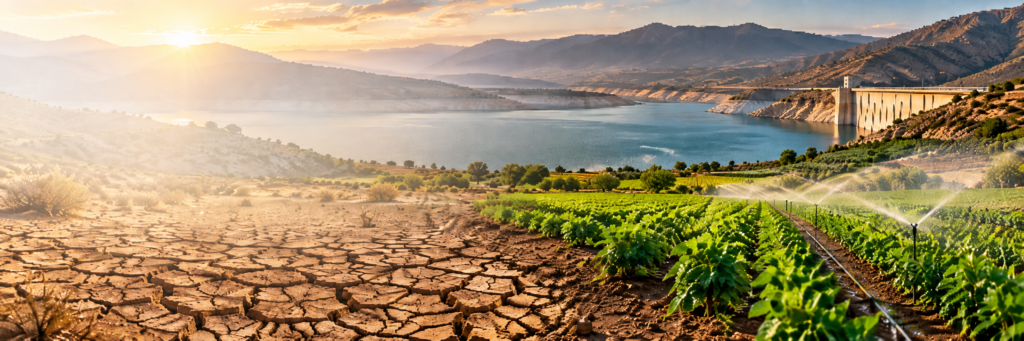
Water remains one of Morocco’s most pressing challenges.
After several years of drought, the 2025–2026 hydrological year brought significant relief. Rainfall helped replenish dam reservoirs and improved water availability across several regions of the Kingdom.
In early September 2026, Morocco’s national dam filling rate reached approximately 67.15%, compared with 33.51% one year earlier. Reservoir levels had even exceeded 76% during the spring before declining over the summer due to water withdrawals and evaporation.
This represents a major improvement, but it does not mean that Morocco’s water challenges have been resolved.
Water availability per capita remains significantly lower than it was several decades ago. In 1960, it was estimated at approximately 2,560 m³ per person per year. Today, depending on the sources and calculation methods used, it stands at around 500 to 650 m³ per person per year.
Morocco therefore continues to face structural water stress.
Why Does Morocco Still Face Water Stress After the Rainfall of 2026?
A year of abundant rainfall can replenish water reserves, but it cannot reverse long-term structural trends.
Morocco’s population continues to grow, cities are expanding, and water demand from agriculture, industry and infrastructure development is increasing.
At the same time, certain groundwater resources remain heavily exploited, while existing water distribution networks require modernization.
The challenge is therefore to manage periods of abundant water availability efficiently while preparing for future dry years.
This is particularly important in a context of increasingly variable weather patterns, where several consecutive years of drought may be followed by exceptionally heavy rainfall within a relatively short period.
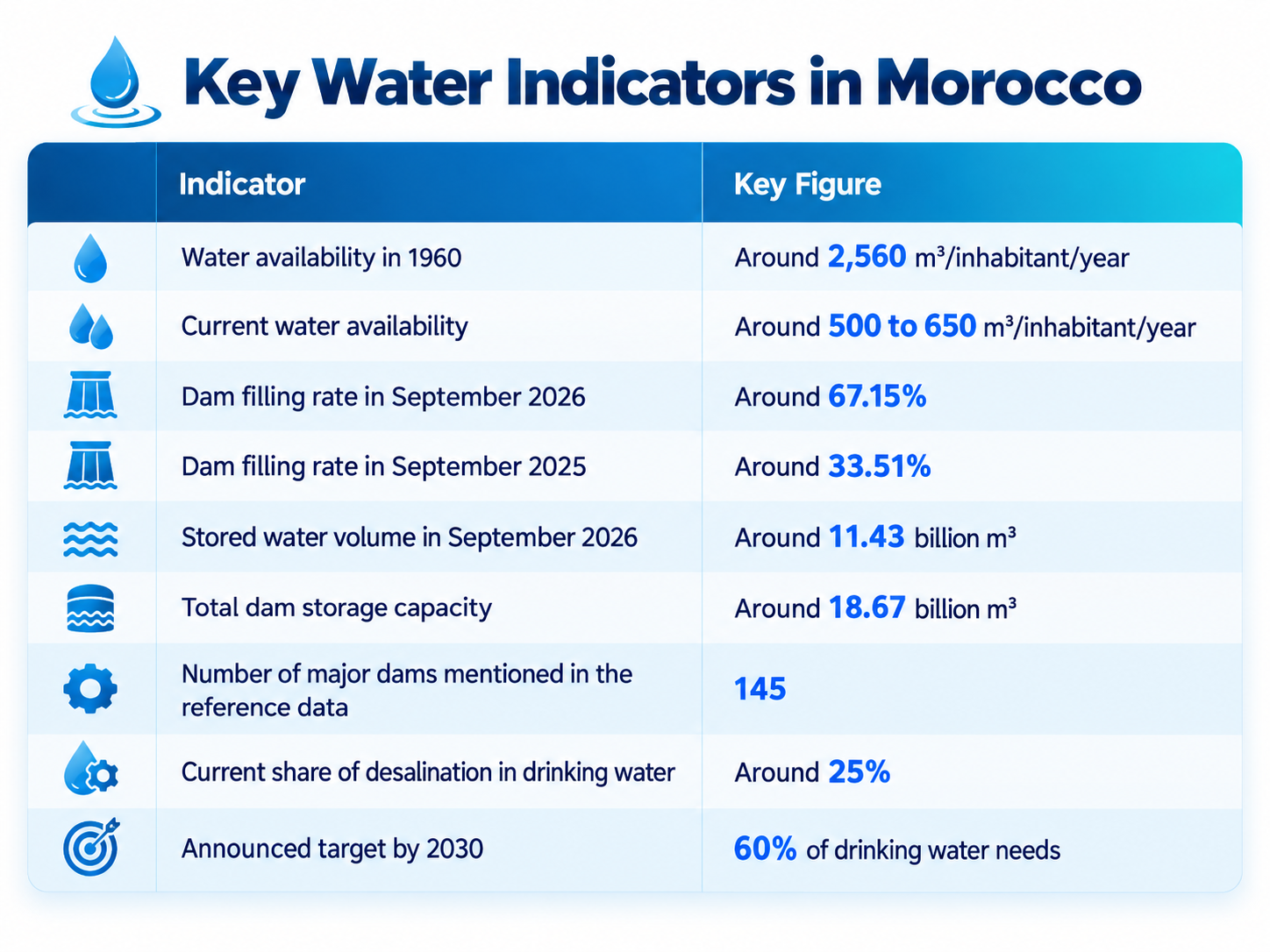
[INSERT IMAGE 1 – Key Water Statistics in Morocco, 2026]
These figures illustrate how Morocco is addressing water security through several complementary approaches: water storage, desalination, network improvement, wastewater treatment and diversification of water resources.
Reducing Water Losses in Drinking Water Networks
Before focusing exclusively on producing more water, it is essential to make better use of the resources already available.
A deteriorated, poorly designed or improperly manufactured pipeline can lead to leaks, pressure losses and repeated maintenance operations.
Over the lifespan of a water distribution network, pipe quality becomes a critical factor in hydraulic performance and long-term reliability.
Selecting a pipe should not be based solely on its diameter or nominal pressure rating. Other essential criteria include:
- Quality and consistency of raw materials;
- Wall thickness uniformity;
- Internal pressure resistance;
- Mechanical strength;
- Dimensional compliance;
- Manufacturing traceability;
- Compliance with applicable standards and specifications.
For drinking water distribution systems, PE100 (high-density polyethylene) pipes and PVC pressure pipes should be selected according to the specific operating conditions of each project and the applicable technical standards.
At ALMA, product quality is supported by laboratory testing and certified management systems.
Quality control tests may include:
- Internal hydrostatic pressure resistance;
- Dimensional inspections;
- Ring stiffness testing;
- Longitudinal heat reversion testing;
- Mechanical property verification;
- Raw material and finished product conformity assessments.
For more information, visit our dedicated page on ALMA Quality and Certifications.
A reliable pipeline represents an investment designed to last for several decades.
In a country facing water scarcity, preventing leaks through properly designed, manufactured and tested piping systems also means protecting a resource that has become strategically important.
Better Water Measurement for More Efficient Management
Sustainable improvements in water network performance require accurate knowledge of the volumes flowing through the system.
Water meters naturally provide consumption measurements, but their role now extends far beyond simple billing.
When combined with district metering, network segmentation and flow monitoring, water meters can help utilities compare the volume of water entering a distribution zone with the amount actually consumed.
An abnormal difference between these values may indicate:
- Water leakage;
- Defective service connections;
- Unusual consumption patterns;
- Metering inaccuracies;
- Potential non-revenue water.
Water metering therefore becomes an essential tool for effective network management.
The modernization of drinking water infrastructure depends not only on reliable pipelines but also on the ability to accurately measure, monitor and analyze distributed water volumes.
Desalination: An Increasingly Essential Water Resource
Morocco has significantly accelerated the development of seawater desalination.
This solution is particularly relevant for a country with an extensive coastline and major coastal urban centers.
Casablanca, Agadir, Laâyoune and Dakhla are among the regions where desalination is playing an increasingly important role in securing water supplies.
According to national objectives referenced in publicly available information, Morocco aims to meet approximately 60% of its drinking water needs through desalination by 2030, with production potentially reaching around 1.7 billion m³ per year.
Desalination provides a water source that is less dependent on rainfall patterns.
However, producing water is only one part of the solution.
Once produced, water must be transported, stored, measured and distributed while minimizing losses.
The expansion of desalination infrastructure must therefore be accompanied by the modernization of water transmission and distribution networks.
Wastewater Treatment and Reuse: Turning Waste into a Resource
For many years, water management strategies primarily focused on developing new sources of supply.
Today, this approach is evolving.
Water that has already been used can become a valuable resource when properly treated.
The reuse of treated wastewater offers significant opportunities for landscape irrigation, selected agricultural applications and various industrial or technical uses.
Depending on the project and the required treated water quality, different treatment technologies can be implemented.
For residential properties, housing developments, hotels, municipalities and industrial facilities, wastewater treatment solutions may include:
- Grease traps and grease separators;
- Septic tanks;
- Imhoff tanks;
- Trickling filters;
- Activated sludge treatment systems;
- Sequencing Batch Reactors (SBR);
- Moving Bed Biofilm Reactors (MBBR);
- Additional treatment and polishing processes designed to improve effluent quality before discharge or reuse.
Through its Almaflow brand, ALMA develops domestic wastewater treatment and reuse solutions tailored to residential developments, communities and private projects.
The objective is not necessarily to produce drinking water.
Instead, wastewater treatment systems aim to achieve a water quality suitable for the intended application while complying with the relevant technical and regulatory requirements.
This approach helps reduce direct wastewater discharges into the environment while limiting the use of drinking water for applications that do not require potable-quality water.
Why Is Water Reuse Becoming Increasingly Important?
Consider a simple example.
Using drinking water to irrigate landscaped areas when properly treated wastewater could serve the same purpose means consuming a high-quality resource for an application that may not require it.
Water reuse addresses two challenges simultaneously.
First, it reduces the amount of wastewater discharged into the environment.
Second, it reduces the demand for additional drinking water in applications where treated water can be safely used.
For hotels, residential developments, industrial complexes and municipalities, these savings can become substantial.
This is why compact wastewater treatment plants and water reuse systems are gaining importance in modern infrastructure and development projects.
Treating Stormwater and Surface Runoff
Not all water requiring treatment originates from households or sanitary wastewater systems.
In parking areas, roads, garages, workshops and service stations, rainfall can wash various pollutants from exposed surfaces.
Stormwater runoff may contain:
- Hydrocarbons;
- Oils;
- Grease;
- Suspended solids;
- Particles resulting from vehicle traffic or industrial activities.
Discharging untreated runoff directly into drainage systems or the natural environment can result in significant pollution.
Specific treatment equipment can therefore be installed upstream of the discharge point.
Grit chambers, oil separators and hydrocarbon separators, with or without bypass systems depending on the installation, help retain certain pollutants before discharge.
These solutions are particularly relevant for:
- Fuel stations;
- Vehicle washing facilities;
- Parking areas;
- Garages and maintenance workshops;
- Industrial facilities;
- Transport and logistics infrastructure.
Selecting the appropriate treatment equipment depends on site characteristics, runoff flow rates, pollution risks and applicable discharge requirements.
Storing Water When It Is Available
The heavy rainfall experienced during the 2025–2026 hydrological year highlighted another essential principle: when water is available in large quantities, the ability to store part of it becomes increasingly important.
Rainwater harvesting can be implemented at different scales.
For individual houses, commercial buildings, industrial facilities and community projects, storage tanks and reservoirs can collect rainwater for suitable non-potable applications.
Potential uses include:
- Landscape watering;
- Irrigation;
- Certain cleaning operations;
- Technical and industrial applications;
- Firefighting water reserves.
Rainwater storage cannot replace major national hydraulic infrastructure such as dams and large reservoirs.
However, at the building or facility level, it can help reduce drinking water consumption and make better use of seasonal rainfall.
Building Water Infrastructure Designed to Last
When discussing water security, major projects such as dams and desalination plants naturally attract considerable attention.
However, day-to-day water management performance also depends on thousands of kilometers of pipelines, service connections, water meters, pumping stations and treatment facilities.
An efficient water infrastructure system must be considered as a complete and interconnected network.
A treatment plant may produce high-quality water, but if the downstream distribution network experiences significant leakage, part of that investment is lost.
Similarly, high-quality pipes alone cannot ensure efficient water management if accurate metering systems are not available to detect and monitor losses.
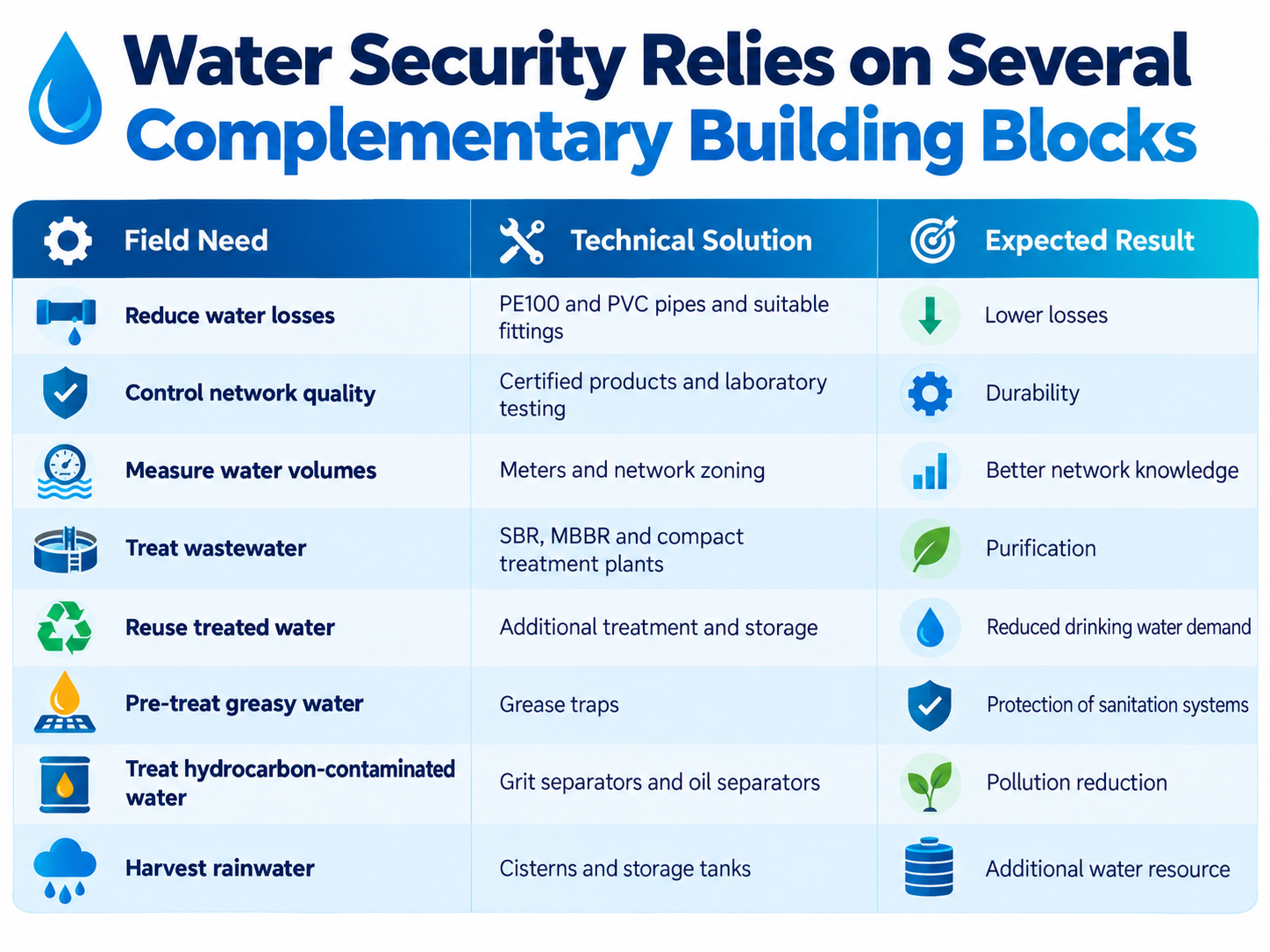
This combination of technologies forms the foundation of modern and sustainable water management.
Reliable piping systems, accurate water meters, efficient pumping infrastructure and appropriate water treatment technologies all contribute to improving the long-term performance of water networks.
What Role Can Municipalities and Industrial Operators Play?
Local authorities and industrial operators can make a significant contribution to more efficient water management.
Before launching a new infrastructure project, several important questions should be addressed:
- How much water will actually be consumed?
- What are the expected peak flow rates?
- What operating pressure is required?
- What types of wastewater will be generated?
- Can some of the water be treated and reused?
- Is the site exposed to hydrocarbon pollution risks?
- Which standards and certifications apply to the equipment?
- What are the expected maintenance and operating requirements?
These questions should ideally be considered during the initial design phase.
Correcting technical problems after construction is generally much more expensive than selecting appropriate piping systems, metering equipment and treatment technologies from the beginning.
For pipes and hydraulic equipment, verifying compliance with applicable standards and certifications is also an important step.
More information about ALMA’s Certifications and Quality Control Procedures is available on our website.
FAQ – Water Scarcity and Water Stress in Morocco
Why Does Morocco Still Face Water Stress Despite the Rainfall of 2026?
Because water stress is primarily a structural challenge.
A wet year can replenish reservoirs and temporarily improve water availability, but the amount of water available per capita remains limited while demand continues to increase.
Long-term water security therefore requires more than favorable rainfall conditions.
What Are Morocco’s Main Water Resources?
Historically, dams and groundwater have played a major role in Morocco’s water supply.
Seawater desalination is becoming increasingly important, particularly for urban and coastal areas.
At the same time, treated wastewater reuse represents a valuable complementary resource for appropriate agricultural, industrial and non-potable applications.
How Can Water Losses in Distribution Networks Be Reduced?
Reducing water losses requires several complementary measures, including:
- High-quality piping systems;
- Reliable fittings and connections;
- Leak detection technologies;
- District metering and network segmentation;
- Pressure management;
- Accurate water metering;
- Continuous network performance monitoring.
Analyzing network performance makes it possible to identify areas where water losses are highest and prioritize corrective actions.
Why Is It Important to Use Certified Pipes?
Water pipelines are generally expected to operate reliably for several decades.
Applicable standards, certifications and laboratory testing help verify whether the product’s declared characteristics are consistent with its required mechanical, dimensional and hydraulic performance.
You can learn more about ALMA’s Certifications and Quality Control Capabilities.
Can Wastewater Really Be Reused?
Yes, provided that the treatment process is appropriate for the characteristics of the wastewater and its intended final application.
Depending on the required water quality and applicable regulations, treated wastewater can be used for certain irrigation, landscape watering and technical applications.
Discover Almaflow’s Domestic Wastewater Treatment Solutions.
Can Desalination Alone Solve Morocco’s Water Scarcity Problem?
No.
Desalination is a strategic water resource, but it must be supported by a broader approach that includes:
- Reduction of water losses;
- Modernization of distribution infrastructure;
- Accurate water metering;
- Improved network efficiency;
- Wastewater treatment and reuse;
- Sustainable management of available water resources.
A comprehensive strategy is essential to improve long-term water security.
Conclusion: Towards More Sustainable Water Management in Morocco
The rainfall recorded in Morocco during the 2025–2026 hydrological year significantly improved national water reserves.
This is encouraging news, but it also represents an opportunity to strengthen resilience against future droughts.
The challenge is no longer simply to produce more water.
It is also essential to transport water more efficiently, reduce leakage, accurately measure consumption, treat wastewater and reuse available resources whenever technically and environmentally appropriate.
Addressing Morocco’s water scarcity challenges therefore requires both major national infrastructure investments and reliable equipment installed throughout local water networks.
High-quality pipelines, accurate water metering and properly designed treatment systems can make a measurable difference over the long term.
ALMA and Almaflow support this transition by providing solutions for drinking water distribution networks, water metering, sanitation and wastewater treatment.
By improving infrastructure quality and promoting efficient water management, Morocco can build a more resilient and sustainable water future.
Explore Our Solutions:
- Discover Almaflow’s Wastewater Treatment and Reuse Solutions
- Learn More About ALMA Quality and Certifications
Sources and References
The general data and information presented in this article are based on publications and publicly available information from the Moroccan Ministry of Equipment and Water, the Maa Dyalna platform, the World Bank, and public reporting by Reuters, Médias24, Le Brief, Maroc Diplomatique and Finances News Hebdo.
Figures relating to water availability, dam reservoir filling rates, desalination capacity and national development targets may change over time.
For long-term accuracy, numerical information should always be considered in relation to its specific reference year.